
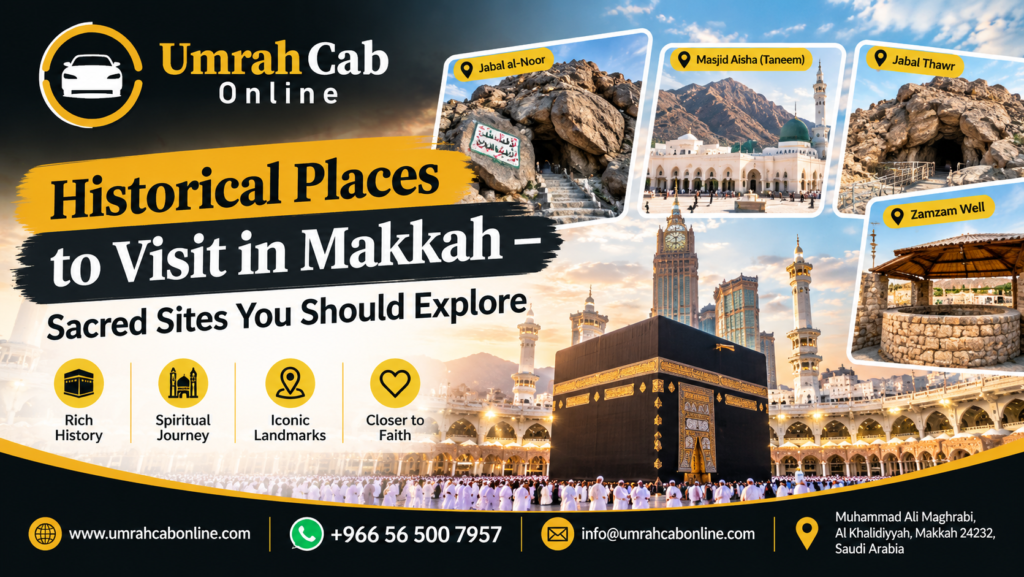
Makkah is one of the most spiritually significant cities in the world. Every year, millions of Muslims from across the globe make their way here — some for Hajj, some for Umrah, and some simply to feel closer to the roots of Islam. But beyond the Grand Mosque and the Kaaba, Makkah is layered with centuries of history waiting to be discovered.
If you’re planning a visit, whether arriving from a nearby city or booking a taxi from makkah to jeddah airport to make the journey comfortable, this guide will walk you through the most important historical places in Makkah that deserve a spot on your itinerary.
1. Masjid al-Haram – The Grand Mosque
No visit to Makkah is complete without spending time at Masjid al-Haram, the largest mosque in the world. At its heart stands the Kaaba — the cubic structure draped in black cloth that Muslims around the globe face in prayer five times a day.
The mosque has been expanded numerous times throughout history, with the most significant expansions occurring under Saudi leadership. Walking through its gates for the first time is an experience that leaves most visitors speechless. The Zamzam Well, located within the complex, is another deeply sacred site — its water is believed to have flowed miraculously since the time of Prophet Ibrahim (AS) and his son Ismail.
2. Jabal al-Nour – The Mountain of Light
A short distance from Masjid al-Haram lies Jabal al-Nour, a mountain that holds one of the most important moments in Islamic history. At its peak sits the Cave of Hira, where the Prophet Muhammad (PBUH) received the first revelation of the Quran through Angel Jibreel (AS).
The climb up to the cave is steep — around 1,200 steps — but the spiritual reward and the view of Makkah from the top make every step worthwhile. Most pilgrims and visitors choose to make this hike in the early morning hours to avoid the midday heat. If you’re traveling from Jeddah and planning to visit multiple sites in one trip, booking a Makkah to Jeddah airport taxi for your return journey in advance saves you a lot of hassle on the way back.
3. Jabal Thawr – The Cave of the Hijra
While Jabal al-Nour marks the beginning of prophethood, Jabal Thawr is associated with one of the most defining moments of early Islamic history — the Hijra, or migration to Madinah. It was in the cave at the top of this mountain that the Prophet (PBUH) and his companion Abu Bakr (RA) sought refuge for three nights while escaping persecution from the Quraysh.
The mountain is located south of Makkah and is slightly more challenging to climb than Jabal al-Nour. Visiting this site connects you to a story of faith, sacrifice, and trust in Allah that shaped the entire future of Islam.
4. Mina – The Tent City
Located just outside Makkah, Mina is one of the most recognized landmarks of the Hajj pilgrimage. This massive tent city comes alive every year during Dhul Hijjah, hosting millions of pilgrims who stay here during the rituals of Hajj.
Mina is also the site of the Jamarat Bridge, where pilgrims perform the symbolic stoning of the devil — a reenactment of Prophet Ibrahim’s rejection of Shaytan. Even outside of the Hajj season, Mina carries an unmistakable sense of history and devotion.
5. Masjid al-Khayf
Nestled within the valley of Mina, Masjid al-Khayf is one of the oldest mosques in Makkah. According to Islamic tradition, many Prophets performed prayers at this very location. It is reported that Prophet Musa (AS) prayed here, making it a site of profound historical and spiritual significance.
During Hajj, pilgrims who stay in Mina often pray their daily Salah at Masjid al-Khayf. Outside of the pilgrimage season, the mosque remains open for visitors who wish to reflect and pray in a place so steeped in prophetic history.
6. Arafat – The Plains of Mercy
Standing on the plains of Arafat is considered the pinnacle of Hajj. It was here that the Prophet Muhammad (PBUH) delivered his Farewell Sermon to over a hundred thousand companions — a moment that encapsulated the final message of Islam on justice, equality, and brotherhood.
The day of Arafat, the 9th of Dhul Hijjah, is when Hajj pilgrims gather here from Dhuhr to Maghrib prayer, supplicating and seeking forgiveness. Even outside Hajj season, visiting Arafat and the Masjid al-Namirah mosque located here is a deeply moving experience.
7. Muzdalifah – Where the Stars Guide the Way
Between Arafat and Mina lies Muzdalifah, an open plain where pilgrims spend the night under the open sky during Hajj. After the standing at Arafat, they travel here, collect small pebbles for the Jamarat ritual, and sleep beneath the stars in a powerful act of unity and humility.
While it is primarily a Hajj-specific site, visiting Muzdalifah outside of that season still gives you a sense of the journey and the simplicity that Islam encourages — a reminder that in front of Allah, every soul is equal.
8. Masjid al-Jinn
Located not far from Masjid al-Haram, Masjid al-Jinn — also known as Masjid al-Haras — marks the spot where a group of Jinn are believed to have heard the Prophet Muhammad (PBUH) recite the Quran and accepted Islam. The event is referenced in Surah Al-Jinn (Chapter 72) of the Holy Quran.
This mosque is lesser known to many pilgrims but is a fascinating site for those who take the time to explore Makkah beyond the main pilgrimage routes.
9. Jannat al-Mu’alla – The Sacred Cemetery
One of the most historically significant cemeteries in the Islamic world, Jannat al-Mu’alla is the resting place of some of the closest relatives of the Prophet Muhammad (PBUH). Among those buried here are Sayyida Khadijah (RA), the Prophet’s beloved first wife, and Sayyid Abd al-Muttalib, his grandfather.
Visiting this cemetery is a moment for quiet reflection and prayer. Many pilgrims make it a point to visit and send salutations upon those buried here.
10. The Birthplace of the Prophet Muhammad (PBUH)
Near Masjid al-Haram, in the neighborhood of Suq al-Layl, lies the site traditionally identified as the birthplace of the Prophet Muhammad (PBUH). Today it houses the Maktaba Makkah al-Mukarramah (the Makkah Library), but its historical significance remains immense. Walking through this area gives you a glimpse into the geography of early Makkah, in the very streets where the last Prophet (PBUH) was born and grew up.
Practical Travel Tips for Visiting Makkah’s Historical Sites
Exploring Makkah’s historical sites requires some planning, especially since the city sees millions of visitors throughout the year. Here are a few tips:
Get There Comfortably: If you’re flying in or out, a reliable taxi from Makkah to Jeddah Airport is one of the easiest ways to manage your travel. The road between the two cities is well-maintained and the drive typically takes between 60 to 90 minutes depending on traffic.
Know the Costs: The Makkah to Jeddah airport taxi fare generally ranges depending on the type of vehicle, time of day, and whether you book in advance or on the spot. Booking in advance through a reputable service usually gives you a fixed rate and peace of mind — especially after long days of ibadah and sightseeing.
Plan Your Timing: Makkah’s historical sites like Jabal al-Nour and Jabal Thawr are best visited in the early morning. The midday heat can be intense, particularly during summer months.
Dress Appropriately: As with all sacred sites, modest dress is expected. Men and women should both cover themselves respectfully when visiting mosques and religious locations.
Stay Hydrated: Makkah’s climate can be extremely hot and dry. Carry water, especially if you plan to hike up any of the mountains.
Final Thoughts
Makkah is far more than a destination — it is a living testament to the history of Islam and the legacy of the Prophets. Every mountain, every mosque, and every stone carries a story that connects the present to the earliest days of the faith.
Whether you are a pilgrim performing Umrah or a Muslim traveler with a few days to explore, taking the time to visit these historical places will leave you with memories and spiritual insights that stay with you for a lifetime.
And when your journey comes to an end, whether you need a Jeddah to Makkah taxi to start your trip or a taxi from Makkah to Jeddah airport to catch your flight home, make sure your travel is as smooth and comfortable as your ibadah deserves.
May every step you take in the blessed city of Makkah be filled with mercy, reflection, and acceptance. Ameen.